
How Long to See Results from Small Business SEO? A Realistic Timeline
Summary:
Small businesses typically begin seeing early SEO results within three to six months, but meaningful growth depends on factors like your industry, competition, website health, and the consistency of your SEO strategy. Rather than focusing on a single timeline, it’s more helpful to understand what progress should look like each month and which metrics indicate you’re moving in the right direction.
One of the first questions we hear after discussing SEO is: “Okay… but how long before I actually see results?” And we get it; it’s a fair question.
Unlike paid advertising, SEO doesn’t flip on overnight. Google needs time to crawl your website, understand your content, and determine whether it deserves to rank. But here’s where many businesses get discouraged. They expect SEO to be silent for six months and then suddenly start generating leads. That’s rarely how it works.
SEO tends to build gradually. The signs of progress usually appear long before new customers start contacting you. The trick is knowing what to look for.
Let’s walk through what a realistic SEO timeline looks like for most small businesses.
SEO Doesn’t Suddenly Start Working. It Builds Momentum.
One of the biggest misconceptions about SEO is that nothing happens until month six. In reality, good SEO behaves more like a snowball than a light switch.
- You make improvements.
- Google notices.
- Your pages begin appearing for more searches.
- People start clicking.
- Some pages perform better than others.
- You refine them.
- The cycle repeats.
Every month builds on the one before it. That’s why we encourage clients to think of SEO as momentum rather than waiting for a finish line.
Month 1: Building the Foundation
The first month rarely produces dramatic rankings. Instead, it’s where the important groundwork happens. That might include:
- Technical website improvements
- Keyword research
- Competitor research
- Content planning
- Optimizing existing pages
- Setting up measurement tools
It can feel slow because much of the work happens behind the scenes. But skipping this stage is like building a house without pouring the foundation.
What to measure
Instead of checking rankings every day, look for:
- Pages being indexed
- Technical issues decreasing
- Baseline impressions in Google Search Console
- Website health improvements
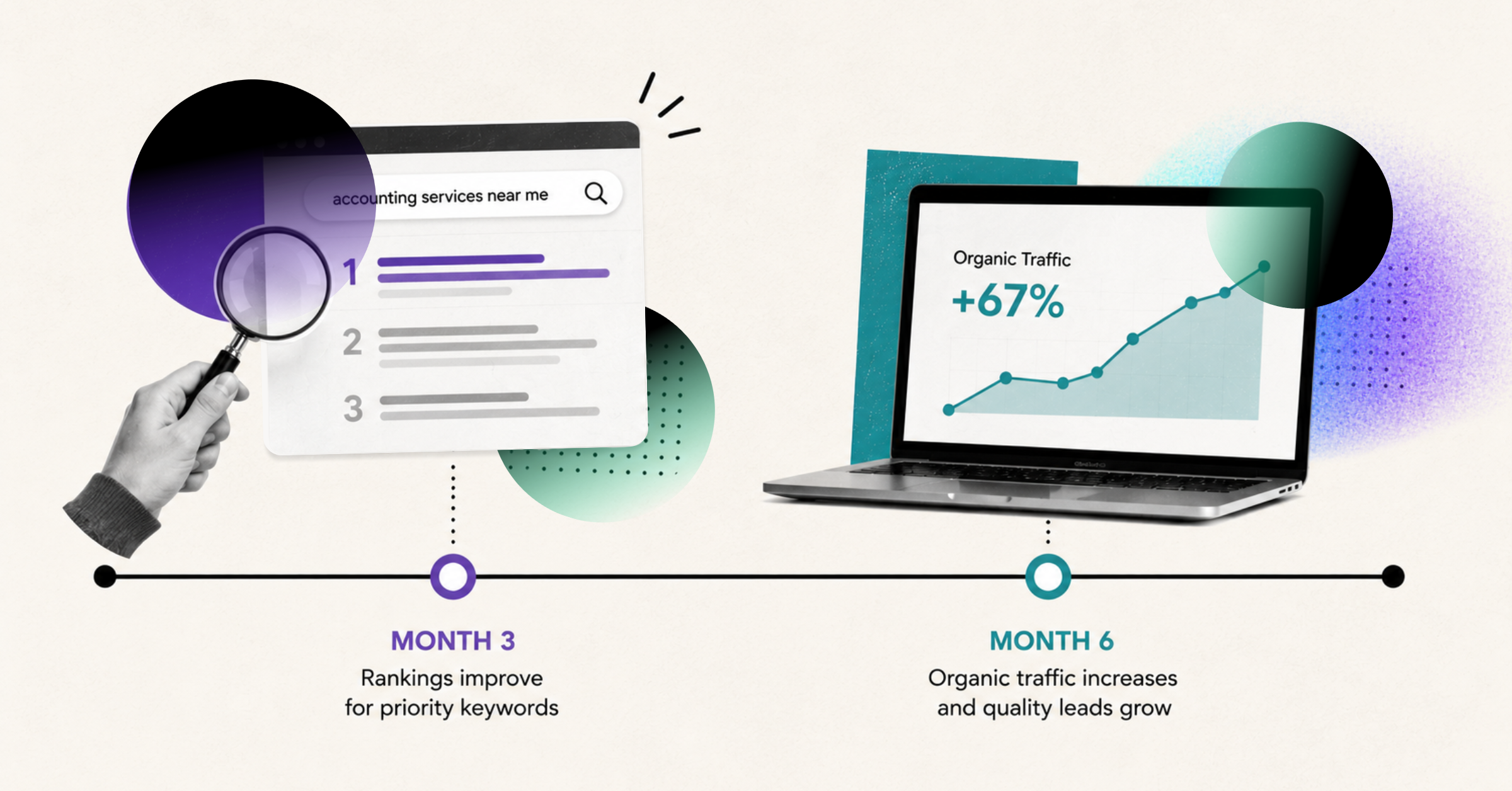
Months 2-3: Google Starts Paying Attention
This is usually when businesses begin seeing encouraging signs. Maybe a service page starts appearing on page two or a new blog receives its first impressions. Or your Google Business Profile gains more visibility.
These aren’t necessarily lead-generating moments yet. They’re signs that Google is beginning to understand your website.
What to measure
At this stage, we pay close attention to:
- Search impressions
- Keyword visibility
- Click-through rate
- Indexed pages
One thing we remind clients often is this: Impressions matter. Even if clicks are still low, impressions tell you people are searching for the topics you’re covering. That’s valuable information because it means your content is beginning to enter relevant conversations.
Months 4-6: Traffic Starts Becoming More Consistent
If your strategy has been consistent, this is often when rankings begin stabilizing. Some blogs start attracting regular visitors. Service pages climb higher in search results. Organic traffic becomes more predictable.
This is also where optimization becomes just as important as creation. Not every page performs equally. Sometimes a page needs a stronger headline or clearer messaging. Sometimes the search intent wasn’t quite right. SEO isn’t just publishing content; it’s improving content over time.
What to measure
Instead of looking at rankings alone, focus on:
- Organic clicks
- Organic sessions
- Conversion rate
- Contact form submissions
- Calls from organic search
Beyond Six Months: SEO Starts Compounding
This is where SEO becomes exciting! You’re no longer starting from zero, and your website now has more content, meaning Google has more context. You’ve collected performance data. You know which topics resonate.
Some pages continue generating traffic without requiring additional work. Others become opportunities for updates and expansion. That’s one of the biggest differences between SEO and many other marketing channels. You’re building assets, not just campaigns.
Why Some Small Businesses See Results Faster Than Others
This is the part many agencies skip (or decide not to tell you). Not every business starts from the same place.
A company with an established website, solid technical health, and years of credibility may see progress much faster than a brand new website. Other factors also influence your timeline:
- Competition in your industry
- The quality of your content
- Local vs. national targeting
- Technical SEO issues
- Website authority
- Consistency
That’s why it’s impossible to promise rankings in a fixed number of days. Anyone who guarantees first-page rankings in a month is making a promise they can’t control.
Don’t Judge SEO Too Early
Let’s use a real-life example.
Imagine going to the gym for three weeks. You probably wouldn’t expect a complete transformation. Well, SEO works the same way.
The businesses that benefit most are usually the ones that stay consistent long enough to let the strategy mature. That doesn’t mean waiting six months without looking at data; it means measuring the right things at the right time.
Early on, impressions matter. Later, clicks matter. Eventually, qualified leads and revenue become the focus. Every stage tells a different part of the story.
So… How Long Does It Take to See Results from Small Business SEO?
Most small businesses begin seeing meaningful signs of progress within three to six months.
However, that doesn’t always mean a flood of new customers. It often starts with stronger visibility, growing impressions, increasing clicks, and steadily improving rankings. The important thing is not to ask whether SEO is working after thirty days. Instead, ask whether your website is becoming more visible than it was last month. Because that’s how sustainable growth happens.
One improvement at a time.
Every SEO Journey Looks Different
There’s no universal SEO timeline because there’s no universal starting point. Some businesses need to improve technical issues before publishing new content. Others already have strong foundations and simply need a better content strategy.
If you're wondering what an SEO roadmap would look like for your business, take a look at our approach to SEO for small businesses.
Keeping it Fluent with this
Quick Q&A
Most small businesses begin seeing early SEO progress within three to six months, although meaningful timelines vary depending on competition, website health, and the consistency of the strategy.
SEO takes time because search engines need to crawl, index, and evaluate your content. One month is typically too early to judge the success of an SEO strategy.
Focus on impressions, indexed pages, keyword visibility, click-through rate, and organic clicks before expecting significant lead generation.
In some cases, yes. Businesses with strong existing websites, low competition, and high-quality content may see progress sooner, but no agency can guarantee rankings within a specific timeframe.
Related Posts
- B2B marketing
- Brand Strategy
- Content Strategy
- Digital Marketing
- Marketing Strategy
- News
- SEO Strategy
- SMB Marketing
- Back
- AI Optimization