


Fluentica Marketing Agency

B2B Marketing

B2B Marketing Funnel: How to Turn Marketing Into Pipeline and Revenue

A B2B marketing funnel is only effective when it connects marketing activity to pipeline and revenue. Traffic, impressions, and engagement mean very little if they do not translate into qualified opportunities. The goal is not to build a funnel that looks complete; it is to build one that moves buyers forward.

Why Most B2B Marketing Doesn’t Turn Into Pipeline

Most B2B companies are not struggling because they are doing nothing. They are struggling because they are doing too many things that do not connect.

Campaigns are running. Content is being published. Ads are spending.

But pipeline stays flat.

The disconnect usually comes down to three things:

  • Marketing is not tied to a clear business strategy
  • Messaging is not differentiated enough to move buyers
  • Performance is measured in activity, not progression

This aligns with what we consistently see: marketing cannot fix a lack of strategy. If the business is not clear on who it serves and why it matters, no amount of campaigns will compensate for that.

What a B2B Marketing Funnel Actually Is

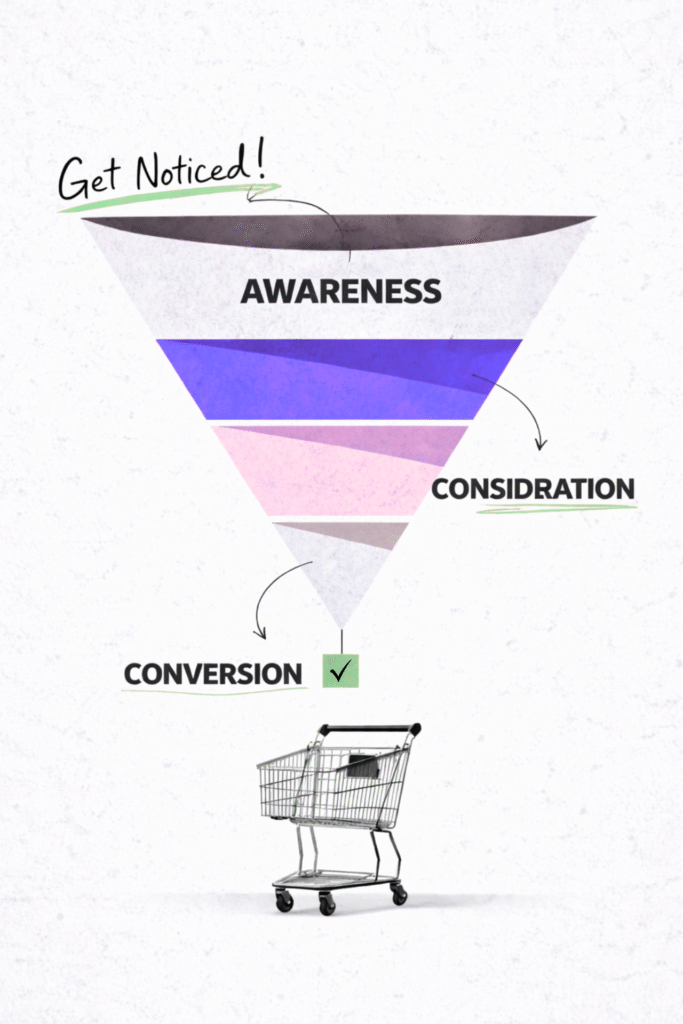
A B2B marketing funnel is the system that moves potential buyers from awareness to decision; but in practice, most funnels fail to connect marketing activity to real pipeline

Research from Gartner shows that B2B buyers don’t move through a linear journey; they revisit stages, gather information independently, and involve multiple stakeholders along the way. The funnel is less of a sequence and more of a system that needs to hold up no matter where someone re-enters. At a basic level, it includes:

  • Awareness
  • Consideration
  • Decision

But in practice, it is more complex than stages. It is about how each stage connects and how momentum is maintained.

A funnel is not:

  • A collection of disconnected tactics
  • A set of campaigns running in parallel
  • A reporting dashboard full of metrics

A funnel is:

  • A structured journey
  • A progression of intent
  • A bridge between marketing and sales

What Actually Happens Inside a B2B Marketing Funnel

stages of marketing funnel b2b

Awareness

This is where buyers first recognize a problem or opportunity. Most companies over-invest here in volume and under-invest in clarity.

Content at this stage should:

  • Address the actual problems your buyers are trying to solve, not what you think they care about, but what they are actively dealing with in their role
  • Reflect how your audience thinks and talks about those problems; the language they use internally, not polished marketing language
  • Create recognition, so when they read it, they feel understood; not just increase visibility

This is where SEO and content play a key role. When done right, content does not just attract traffic; it attracts the right questions. That is why thinking in terms of how B2B companies drive growth through digital marketing is more useful than publishing isolated blog posts.

Consideration

This is where buyers start evaluating options and where most funnels break. Why? Because companies:

  • Repeat the same message from awareness
  • Fail to differentiate
  • Do not build trust

At this stage, buyers are asking:

  • Why you
  • Why now
  • Why should I trust your product or services

If your content and messaging cannot answer those questions, the funnel stalls.

Decision

This is where intent becomes action. At this stage, marketing and sales must be aligned. Buyers need:

  • Clear value: how this actually impacts their business; not features, but outcomes tied to pipeline, revenue, or efficiency
  • Proof: real signals that this works; case studies, results, or examples that reduce perceived risk
  • Confidence: clarity on what happens next; how the process works, what the investment looks like, and what they can expect

This is where real-world signals matter. Case studies, even when presented subtly, help reduce friction. We have seen this in campaigns where aligning messaging with outcomes, not features, improves engagement quality and makes follow-ups more effective.

Where B2B Funnels Actually Fail

broken clip icon

Misalignment between marketing and sales

Marketing generates interest; sales expect readiness. Marketing is focused on driving engagement and bringing people into the funnel. Sales is focused on closing, which means they are looking for buyers who are already clear on their needs and ready to move forward.

Without alignment:

• Marketing considers someone qualified based on activity
• Sales expects someone qualified based on intent

no brand communication icon

Weak Positioning

If your message sounds like everyone else's, it’s usually because it is. Most B2B companies repeat the same claims: “AI-powered solutions, ” “end-to-end platform, ” “Data-driven approach, etc.”

None of these are wrong; they’re just not differentiating. When every company is “AI-driven,” buyers stop using that as a signal. It becomes background noise.

• Buyers do not remember you
• Comparisons become price-based
• Decision cycles get longer

measuring marketing magnifier icon

Measuring the Wrong Things

Many teams still prioritize impressions, clicks, and traffic. These metrics matter; they show that your marketing is reaching people and generating interest. If they are flat, nothing else moves. But on their own, they don’t tell you if your marketing is actually working. You can see: traffic increasing, campaigns getting engagement, and content bringing visitors.

And still have no real change in: qualified leads, conversion rates, and pipeline That’s where the disconnect happens. Impressions and clicks tell you people are paying attention. They don’t tell you if those people are moving forward.
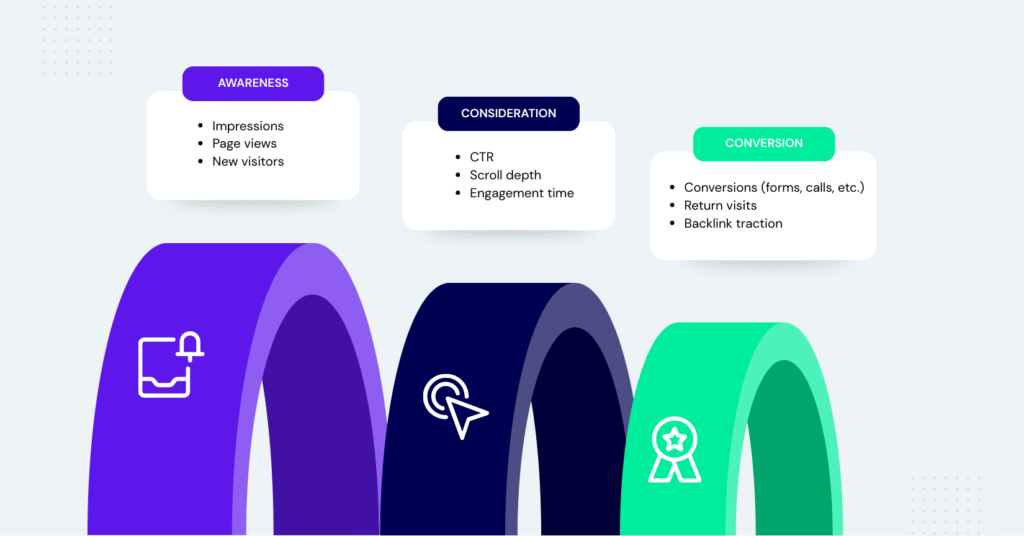

How to Measure Actual Progress

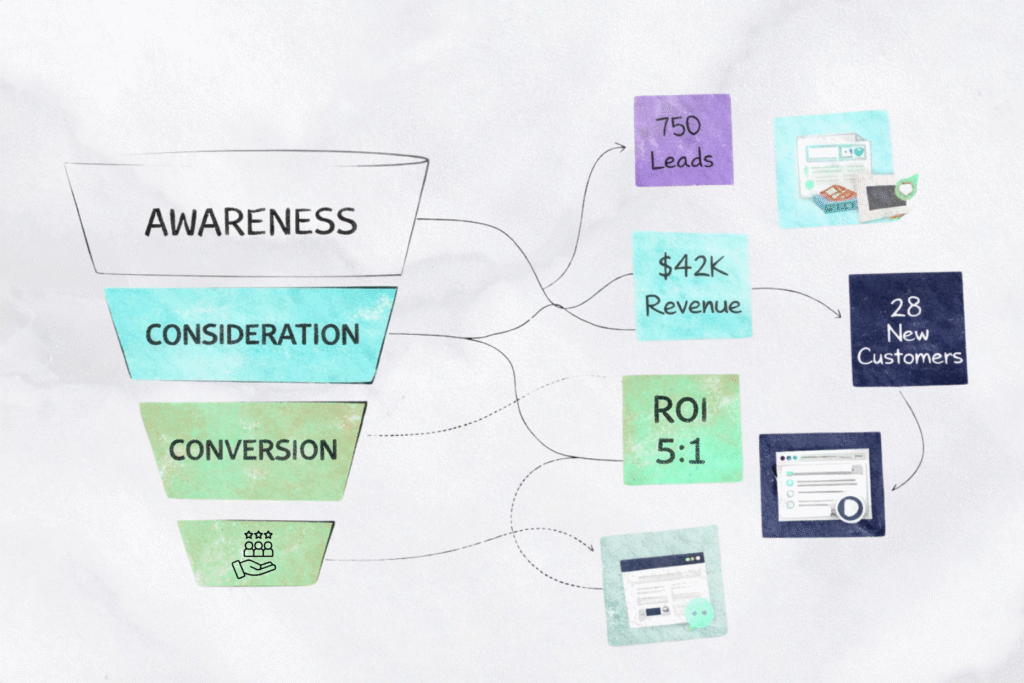
What actually shows progress is how those numbers translate into movement:

  • Of the people clicking, how many convert
  • Of those who convert, how many become qualified
  • Of those qualified, how many turn into opportunities

That’s how you connect channels to pipeline. Channels give you the numbers. The funnel tells you what those numbers mean.

Organizations like HubSpot and Salesforce emphasize lifecycle tracking for this reason; visibility into progression is more valuable than surface-level performance.

metric to measure content performance

The Metrics That Tell You if Anything Is Actually Working

If the goal is pipeline, then measurement needs to reflect movement.

There’s been a shift toward tying marketing performance to revenue outcomes rather than activity metrics; not because it sounds better, but because activity alone doesn’t explain what’s actually working.

Your team should focus on:

Pipeline contribution

How much pipeline marketing is influencing, not just generating.

Conversion by stage

Where people drop off, not just where they enter.

Sales velocity

How fast opportunities move through the funnel.

Customer acquisition cost (CAC)

How efficiently growth is being achieved.

How To Build a B2B Funnel That Drives Pipeline

Start with business strategy, not tactics

Before launching campaigns, we always bring the conversation back to the business goal. At Fluentica, we guide clients through questions like:

  • What are you trying to achieve: more pipeline, faster sales cycles, better conversion?
  • What does success actually look like for the business, not just for marketing?

From there, we define what marketing needs to do.

  • If the goal is to increase pipeline, then marketing focuses on attracting and converting the right audience. 
  • If the goal is to improve conversion, then the focus shifts to messaging, positioning, and funnel flow.

Align messaging across stages

Your message should evolve, not reset.

  • Awareness introduces the problem
  • Consideration deepens understanding
  • Decision reinforces confidence

Consistency builds trust; repetition without depth creates friction.

Connect content to intent

Content should not exist in isolation. This is something we see often: companies publish content that performs on its own, but doesn’t connect to anything else.

Each piece should:

  • Match where the buyer is in their thinking; early-stage content is not the same as decision-stage content
  • Point somewhere; whether that’s another piece of content, a clearer explanation, or a next step in the process
  • Reinforce the same message, so over time, the buyer builds a clear understanding of your value

This is where many strategies fall short. Publishing content without a system behind it leads to visibility without impact.

Integrate marketing and sales early

Alignment should not happen at the handoff; it should happen from the start. That starts with alignment:

  • Define what a qualified lead looks like, based on intent, not just activity
  • Agree on expectations; what sales needs vs. what marketing is driving
  • Create feedback loops, so both teams adjust based on what’s actually happening

But it doesn’t end there. Marketing also plays a role during the sales process:

  • Reinforcing the message through case studies, content, and follow-ups
  • Addressing objections through targeted content or proof points
  • Supporting multiple stakeholders who enter the conversation later

Because in B2B, decisions don’t happen in one conversation. When marketing and sales stay connected throughout, the funnel doesn’t break at the bottom; it keeps moving.

Optimize based on movement, not volume

Instead of asking:
“How do we get more traffic?”

Ask:
“Where are we losing momentum?”

This shift changes how decisions are made and where effort is invested.

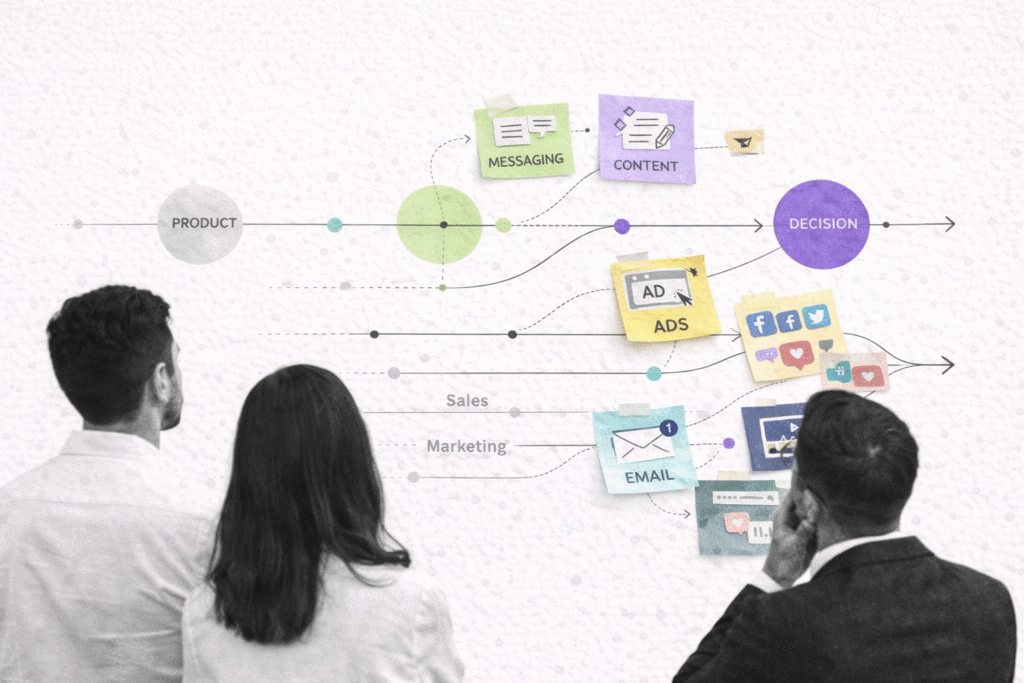
marketer measuring marketing efforts white board

Budget Allocation: Where It Actually Matters

Budget is often spread too thin across channels (and rarely unlimited, if you ask us!)

For most founders, CEOs, or marketing leads, every dollar comes with a question: Is this actually going to move the business forward?

That’s why budget often ends up spread too thin across channels.

There’s an attempt to:

  • be present everywhere
  • test multiple tactics at once
  • not miss potential opportunities

But in practice, this creates fragmentation. A better approach is more focused:

  • Invest in what moves buyers forward, not just what drives visibility
  • Double down on what shows progression, where engagement turns into real conversations
  • Reduce what only creates surface-level activity, even if it looks good in reports

Because budget is not just about how much you spend; it’s about how clearly that spend connects to outcomes. Campaign optimization is not just about efficiency; it is about making deliberate choices on where to focus.

Where Things Start to Fall Apart

If you’re reading this and thinking “we’re already doing most of this,” you’re probably right.

Most teams we speak to are not starting from zero. They have:

  • campaigns running
  • content being published
  • some level of inbound or outbound working

And still, pipeline feels inconsistent.

That gap usually shows up in ways that are easy to overlook:

  • Content brings traffic, but not the right conversations
  • Sales says leads are not ready; marketing says they are
  • Messaging sounds good internally, but doesn’t land externally
  • Budget is being used, but not clearly tied to outcomes

None of these are surface-level problems. They are structural. And that’s the part that often gets missed.

What We’ve Seen When Things Start To Click

complete consumer journey b2b saas funnel

The shift is rarely about doing more; it is about connecting what already exists. In projects where funnels start working the way they should, a few things tend to change:

We’ve seen this play out in different ways.

In one case, shifting from blog-heavy assets to proof-driven content, like testimonials and real outcomes, improved engagement quality without increasing spend.

In another, aligning SEO content with real buyer concerns, not just keywords, helped drive visibility for non-branded searches that were actually tied to intent.

None of this came from adding more channels. It came from making the funnel make sense.

The Part No One Says Out Loud

There’s usually a moment where founders or marketing leads start questioning the whole system. Not because nothing is working, but because it’s unclear what is. You might be seeing:

  • Some leads are coming in, but not converting
  • Some campaigns are performing, but not scaling
  • Some content ranking, but not driving pipeline

And the question becomes:  “Are we missing something, or is this just how it is?”

Most of the time, it’s not how it is. It’s a sign that:

  • Strategy and execution are slightly misaligned
  • Messaging is not carrying through the funnel
  • Or the measurement is not telling the full story

Once that’s addressed, things don’t just improve; they become clearer. And clarity is what allows growth to become repeatable.

What This Usually Looks Like From the Inside

If You’re Looking At Your Funnel Right Now…

Most teams don’t come to us saying, “We need a funnel.” They come with something more specific:

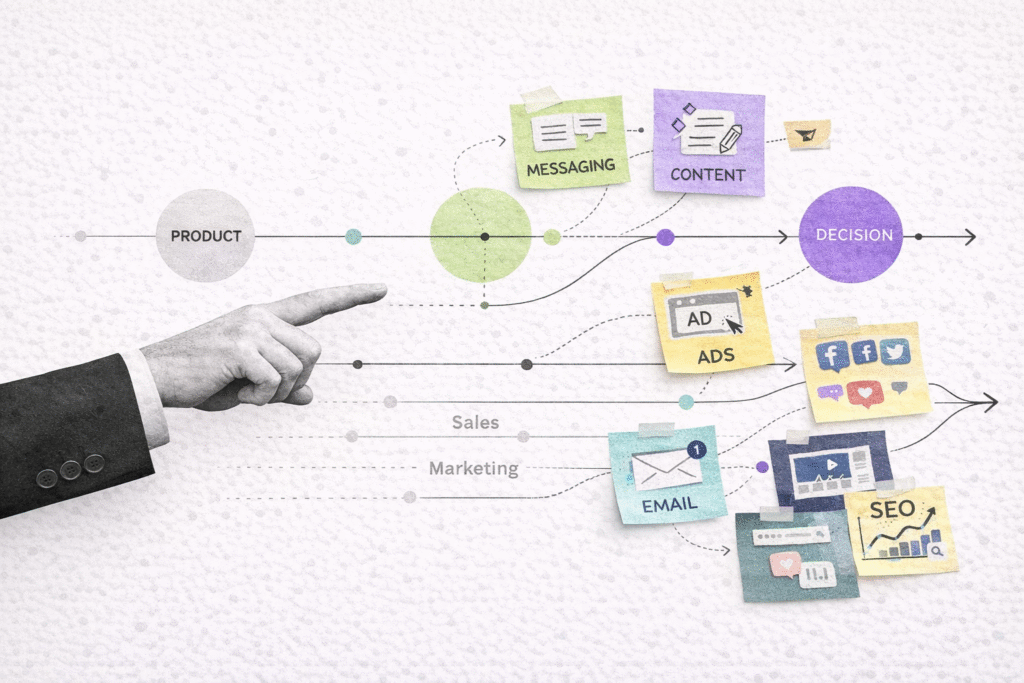
consumer journey b2b marketing pipeline

Different symptoms; same root issue. The funnel is not broken because it doesn’t exist; it’s broken because it’s not connected.

And once that connection is rebuilt, across strategy, messaging, and measurement, marketing starts doing what it’s supposed to do: Move the business forward.

If you’re thinking through how this applies to your own funnel, it usually helps to look at it from different angles; not just structure, but how content, messaging, and performance connect.


Some areas worth digging into:

Your marketing might be generating activity; but if it’s not translating into pipeline, something is disconnected.

In most cases, it’s not one big issue. It’s small gaps across strategy, messaging, or how performance is being measured; and how those pieces connect across the funnel.

Once that becomes clear, everything else becomes easier to fix.

If you want a second perspective on where that disconnect might be, we’re always open to taking a look.

Scroll to Top