

Building Pipeline Through Content: Why More Content Isn’t Always the Answer

Summary:
Building pipeline through content does not mean publishing more blogs and waiting for leads to appear. Content contributes to pipeline when it addresses problems your buyers actually have, matches where they are in the buying process, gives them a logical next step, and is measured beyond traffic and engagement.
If your traffic is growing but your pipeline isn’t, the problem may not be how much content you produce. It may be what the content is designed to do. At Fluentica, we use a simple way to think about this: Problem. Intent. Path. Evidence. We call it the PIPE Framework, and we’ll break it down below.
You’re Producing More Content. So Why Isn’t Pipeline Growing?
You publish a blog every week. Your SEO report shows more keywords ranking. Organic traffic is going up. People are viewing your LinkedIn posts. Maybe engagement is growing too.
Then you sit down with sales. “Is this content actually helping us close anything?” And suddenly, those charts showing impressions and pageviews feel a lot less exciting.
This is a very common content marketing problem, particularly in B2B.
The immediate reaction is often to produce more: more blogs, more LinkedIn posts, more downloadable guides, more SEO pages.
But more content does not automatically create more pipeline.
Sometimes, you have a content production machine when what you actually need is a content strategy connected to how people buy. There’s a difference.
Traffic Growth and Pipeline Growth Are Two Different Things
Traffic matters, rankings matter, engagement matters– sure! They can tell you whether people are finding your business and paying attention to what you’re saying.
But none of those metrics, on their own, tell you whether the right person is getting closer to becoming a customer.
Imagine you sell cybersecurity services to healthcare organizations. You publish:
“10 Interesting Technology Trends to Watch This Year.” You see it take off; thousands of people visit it.
Now compare that with another article: “What Should a Healthcare Organization Ask Before Hiring a Managed IT Provider?” Maybe only 200 people read that one.
Which article would you rather have a potential customer reading two weeks before they contact your sales team? Probably the second. That doesn’t make the first article useless. It simply means the two pieces are doing different jobs.
And that’s where companies can get content measurement wrong. More traffic is not the same thing as more buying intent.
Google itself recommends creating content primarily for people rather than producing pages mainly to attract search traffic. SEO can get someone through the door, but your content strategy still has to decide what happens once they arrive.
Not Every Piece of Content Needs to Generate a Lead
This is where we need to be transparent. If someone tells you every blog post should generate leads, we disagree. That’s definitely not how most B2B buying journeys work.
Someone might first encounter your company through an educational article.
A month later, they see one of your social media posts– perhaps on LinkedIn.
Then their boss mentions that the company finally needs to solve the problem you’ve been talking about.
They return to Google, then they visit your service page. Someone from their team reads a case study. Eventually, they request a meeting.
Which piece of content generated the lead?
The service page? The first blog? The case study? Google? LinkedIn?
The answer can be all of them influenced the decision in different ways.
That is precisely why attribution gets messy. Multi-touch attribution exists because customer journeys can involve multiple marketing interactions before a conversion, rather than one neat first-click-to-sale path.
Your marketing objective isn’t to force every piece of content to produce an immediate conversion. The goal is to understand what role your content is playing.
The Fluentica PIPE Framework for Building Pipeline Through Content
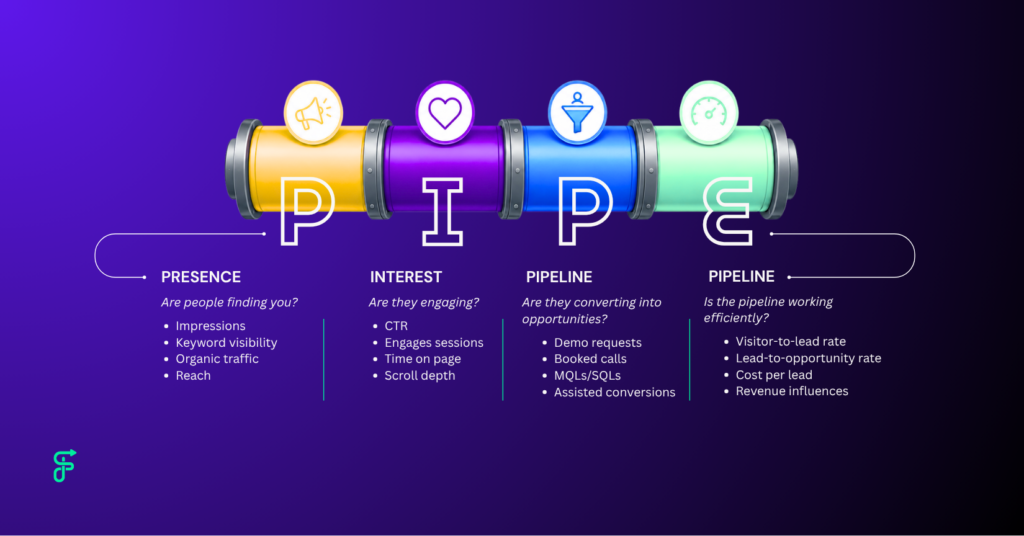
When we think about content that can influence pipeline, we look at four things:
P — Problem
I — Intent
P — Path
E — Evidence
You can use the PIPE Framework before producing content and again when evaluating what you’ve already published. Let’s take a look at how we do it.
P: Problem — Start With What the Buyer Is Actually Trying to Solve
Before opening your keyword research tool, ask: What business problem is behind this content?
- Not: “What should we publish this week?”
- Not: “What keyword has 1,000 searches?”
- And definitely not: “What is everyone else blogging about?”
Start with the buyer. What is happening inside their company that might eventually cause them to look for a business like yours?
Some of the best sources for these problems aren’t marketing tools. They’re sitting inside your company.
Ask your sales team:
- What questions do prospects repeatedly ask?
- What do people misunderstand about your service?
- What objections slow down a deal?
- What alternatives are prospects comparing you against?
- What makes someone finally decide they need this?
- What information do you constantly explain on sales calls?
Ask customer service or account teams:
- What surprised customers after they started working with you?
- What problems were they dealing with beforehand?
- What questions do new customers commonly have?
Then use SEO research to understand how people are searching around those problems. That’s very different from beginning with a giant list of keywords and trying to manufacture 30 articles from it.
One sales conversation can become several pieces of content
Suppose prospects keep asking: “Do we really need an outsourced marketing team if we already have someone internally?” That question might become:
- A comparison blog
- A LinkedIn post
- A short video
- A section on your services page
- A case study showing how an agency worked alongside an internal team
- A sales resource your team can send after a meeting
Now your content isn’t filling a calendar. It’s helping answer a buying question.
I: Intent — Know What Job the Content Is Supposed to Do
Once you have the problem, determine the reader’s intent.
Someone searching: “What is account-based marketing?” is in a very different place from someone searching: “ABM agency vs in-house team.”
And they’re both different from someone searching: “B2B marketing agency New York.”
All three searches could matter. But expecting all three pages to produce the same result makes no sense.
A straightforward way to map content is:
Early-stage content: Help me understand
The buyer is recognizing or researching a problem. Examples:
- Why isn’t our SEO generating leads?
- What is demand generation?
- Why is customer acquisition getting more expensive?
- How much should a startup spend on marketing?
Measure things like qualified organic visibility, engaged visits, return visitors, newsletter subscriptions, and whether readers continue deeper into your site.
Mid-stage content: Help me evaluate
The buyer knows they have a problem and is figuring out what to do about it. They might be searching for:
- Agency vs in-house marketing team
- SEO vs paid search for B2B
- What should be included in a B2B marketing strategy?
- How long should SEO take to generate leads?
Look for movement toward solution pages, case studies, repeat visits, and other higher-intent actions.
Decision-stage content: Help me choose
Now the buyer is evaluating providers or solutions. They want more straightforward proof of your services/product such as:
- Case studies
- Comparison pages
- Pricing information
- Implementation/process pages
- Service pages
- FAQs based on sales objections
Here, demo requests, contact submissions, qualified leads, opportunities, and sales conversations become much more meaningful metrics.
A healthy content strategy needs more than one of these stages.
If nearly everything you’re publishing sits at the top, you may be generating plenty of awareness without giving interested buyers much help taking the next step.
P: Path — Give People Somewhere Useful to Go Next
This is one of the easiest problems to fix.
You write a great article, someone reads it, and they get to the bottom. And then… nothing.
Maybe there’s a generic:
Contact us today! Or a newsletter signup. Or six completely unrelated “recommended articles.”
You’ve earned the reader’s attention. Now give them a next step that makes sense based on what they were just reading.
If someone reads: “How Much Does Managed IT Cost?” a logical next step might be: “Compare Managed IT vs an In-House IT Team.”
From there: “View Our Managed IT Services.”
And then: “Talk to Our Team.”
That is a path. It doesn’t need to be manipulative, and every step does not need to scream BOOK A DEMO. You’re simply making it easier for someone who wants more information to keep moving.
Look at your existing content
Choose your 10 or 20 most-visited pieces and ask:
- What intent brought someone here?
- What question are they likely to have next?
- Do we already have content that answers it?
- Are we linking to it?
- Is there eventually a clear route to the product or service related to that problem?
You may discover you don’t need another 20 articles. You need to connect the 20 you already have.
E: Evidence — Measure Movement, Not Just Consumption
Now comes the part that usually creates the disagreement between marketing and sales. Marketing says:
“The content is performing.”
Sales says:
“Where are the leads?”
Both can be looking at accurate data. But the problem is that they’re looking at two completely different definitions of performance. You need evidence between: someone consumed content, and someone became a customer.
That doesn’t mean building an attribution system so complicated that nobody trusts it. Start simpler.
1. Track meaningful conversions in GA4
Make sure actions that matter to the business are actually being measured. Depending on your business, that could include:
- Contact form submissions
- Demo requests
- Consultation requests
- Phone-call clicks
- Trial registrations
- Important downloads
- Other high-intent actions
GA4 allows businesses to create conversions from events representing important actions on the site. If those actions aren’t being tracked correctly, arguing about content ROI is premature.
2. Look at what people do after reading content
Don’t stop at: Blog received 1,200 visits. Ask: What percentage continued to a service page?
Did they visit another article? Did they look at a case study? Did they return later? Did they eventually convert?
That starts telling you whether the content is attracting attention and creating movement.
3. Compare content with qualified leads
If you use a CRM, look at the contacts and opportunities coming in. Which content did qualified prospects consume? Are certain pages repeatedly appearing in the journeys of good leads?
This doesn’t mean declaring: “Blog #14 generated this entire $50,000 opportunity.” It means looking for patterns.
4. Look at attribution paths
GA4’s attribution reports can help businesses understand the touchpoints customers interacted with before completing a conversion.
Your CRM may provide additional information about what happened after the lead was created. However, neither system will magically explain every B2B buying decision.
But together, they give you much more useful information than pageviews alone.
5. Ask sales whether they’re actually using the content
This one isn’t particularly sophisticated, but it’s incredibly useful. Ask sales: “What content have you sent to a prospect this month?”
If the answer is “none,” ask why.
Maybe sales doesn’t know what exists. Maybe the content isn’t useful during a sales conversation. Or maybe marketing hasn’t created the content sales actually needs.
A case study that helps a salesperson overcome the same objection five times can be extremely valuable even if Google Analytics shows 47 pageviews.
A Real Example: What We Saw With ABA Matrix, a SaaS Company
ABA Matrix, a SaaS platform for ABA therapy providers, is a useful example of why we don’t like evaluating content one blog at a time.
When the SEO work began, the company had essentially no meaningful organic visibility. The strategy wasn’t simply “publish more blogs.”
We worked around the problems and questions relevant to ABA providers, mapped keywords to search intent, developed content around those themes, strengthened internal linking, and connected the content to the broader website and SEO strategy.
Over time, ABA Matrix grew to rank for thousands of keywords, generate more than 30,000 monthly organic visits, and bring in 30+ marketing-qualified leads per month through organic visibility.
But here’s the important part: We would not tell you that every one of those leads existed because of one specific blog post.
We also didn’t have clean enough MQL-to-revenue attribution to tell you that content created an exact dollar amount of closed revenue. So we wouldn’t make that claim.
What we could clearly see was the bigger pattern:
Relevant search visibility grew → the right audience found the company → content supported their research → qualified leads increased.
That’s a much more useful way to evaluate a body of content than asking whether Blog A generated three leads and Blog B generated zero.
Stop Measuring Every Blog Like a Tiny Salesperson
This is one of the biggest changes we’d recommend. Companies often look at a content report like this:
|
Blog
|
Traffic
|
Leads
|
|---|---|---|
|
Blog A
|
2,450
|
3
|
|
Blog B
|
760
|
0
|
|
Blog C
|
1,100
|
1
|
Blog B looks like a failure. But what if Blog B ranks for an important problem your target audience searches for?
What if prospects consistently encounter it first, return later through branded search, and then convert through your services page?
What if sales sends it during conversations?
What if it strengthens an entire SEO topic cluster that drives qualified traffic?
Evaluating it purely based on its last-click leads misses the point. Instead, zoom out.
Measure content in groups
Start organizing content around:
- audience problem
- product or service
- search intent
- buyer stage
- content cluster
Then ask:
- Is this group of content helping us become more visible for the problem we want to own?
- Are the right people entering through it?
- Are they moving deeper into the website?
- Are qualified leads interacting with it?
- Are opportunities being influenced by it?
That’s much closer to a business conversation.
Before You Publish Another Blog, Run It Through PIPE
Here’s the short version of our PIPE Framework in action.
Problem
What real buyer or sales problem does this address? If the answer is just “we need an article this week,” reconsider it.
Intent
What is the person trying to accomplish when they consume it? Understand? Evaluate? Choose? Know the job before measuring its performance.
Path
What should someone logically do or read next? Build that connection intentionally.
Evidence
What would tell us this content is helping someone move? Traffic may be one signal. It shouldn’t automatically be the last one.
And Sometimes, Your Content Isn’t the Problem
There’s one more possibility agencies don’t always like talking about.
You could be producing genuinely good content… and still have a pipeline problem.
Maybe people are not connecting with your content, don’t understand your offer, or you’re attracting the wrong audience.
Maybe there’s very little demand in the market. Maybe your service pages don’t explain why someone should choose you.
Maybe prospects are converting, but the sales follow-up isn’t working.
Maybe your pricing or positioning is the problem. Or your marketing and sales teams disagree about what a qualified lead actually is.
Publishing another eight blogs won’t fix those things. Marketing cannot compensate indefinitely for a larger business, positioning, product, or sales problem.
Content can create visibility: it can explain, build trust, answer objections, capture demand, help buyers make decisions. And yes, it can absolutely contribute to pipeline. But only when it is connected to everything around it.
Building Pipeline Through Content Starts With the Pipeline
If you’re producing content consistently and wondering why it isn’t translating into pipeline growth, don’t immediately increase your publishing frequency.
Go the other direction. Start with your customers, start with sales, start with the problems that create opportunities. Then work backward into content.
Use Problem → Intent → Path → Evidence to decide what deserves to be created and how you’ll evaluate whether it’s working.
You may still end up publishing every week, but now you’ll know why you’re publishing. And that’s a much better place to start.
If you’re not sure how these stages fit together, our B2B Marketing Funnel breaks down how buyers move from awareness to decision and where marketing should support them along the way.
Related Posts
- B2B marketing
- Brand Strategy
- Content Strategy
- Digital Marketing
- Marketing Strategy
- News
- SEO Strategy
- SMB Marketing
- Back
- AI Optimization