
B2B Content Marketing Funnel: How to Move Buyers from Awareness to Revenue
- October 12, 2026
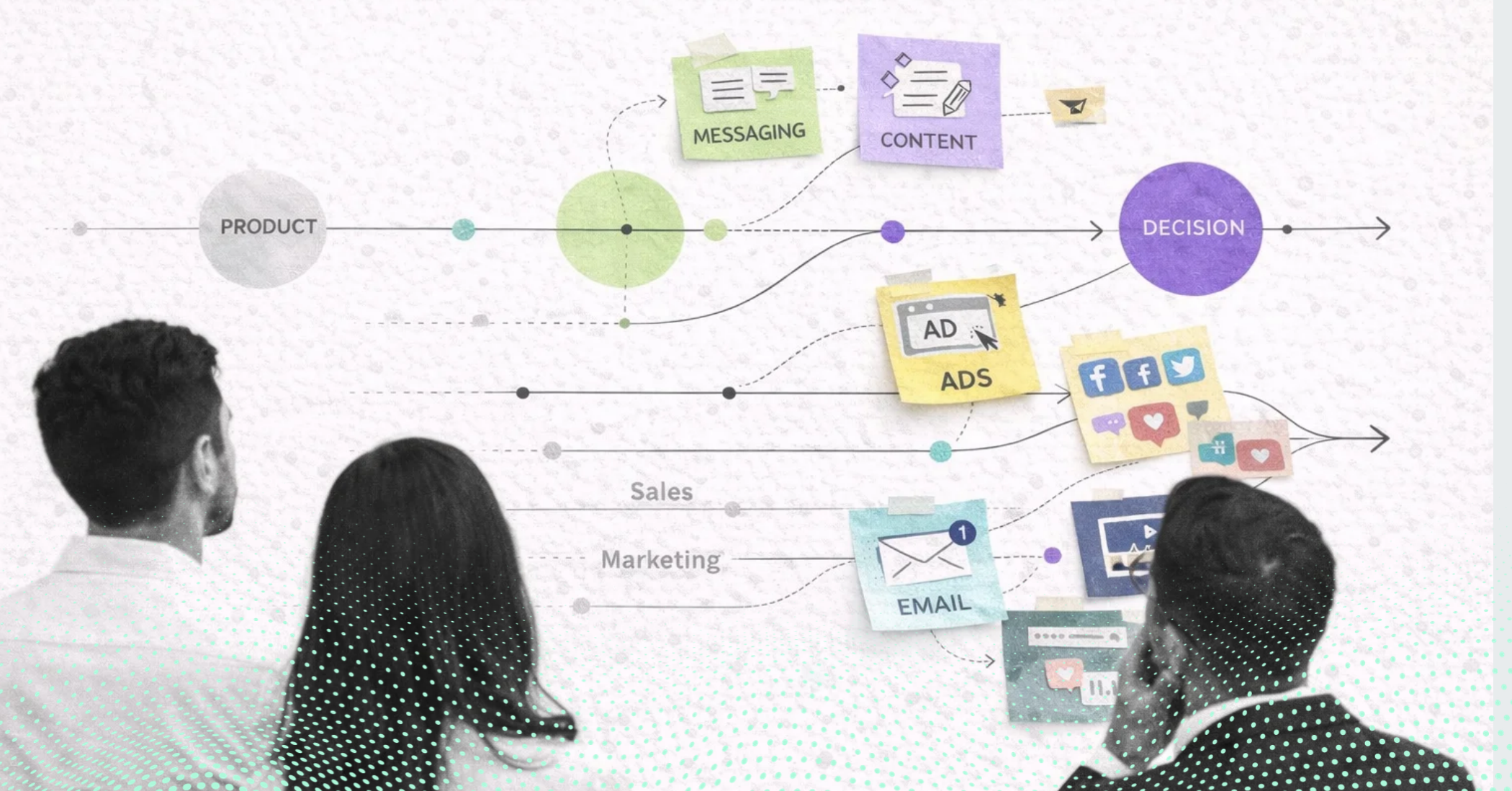
A B2B content marketing funnel is a strategic framework that maps specific content assets to each stage of the buyer journey, from initial awareness through closed revenue. Unlike B2C purchases, B2B sales cycles last weeks to months, and buying committees of 6 to 10 stakeholders each need different information at different times. The b2b content marketing funnel connects what you publish to what your pipeline actually needs.
Here is the problem most B2B marketing teams face: you produce content, but it does not connect to how buyers actually make purchase decisions. Your sales team says leads are not ready. Your CEO wants pipeline proof, and “brand awareness” is no longer acceptable. The fix is not more content. It is inverting your production ratio to 40% MOFU, 35% BOFU, 25% TOFU and mapping every asset to a buyer stage, buying committee role, and deal friction point.
Before reading further, run this 3-step diagnostic on your current b2b marketing funnel:
- Tag every content asset from the last 90 days as TOFU, MOFU, or BOFU. If more than 50% is TOFU, your funnel is top-heavy and stalling at awareness.
- Check your MQL-to-SQL conversion rate. Below 20% means your consideration stage content is not building enough trust for sales handoff.
- Ask your sales team which content they use in late-stage conversations. If the answer is “none,” your BOFU layer is missing.
Why the Standard Marketing Funnel Model Is Already Wrong
Every top-ranking article on the B2B marketing funnel presents a linear TOFU-to-MOFU-to-BOFU path. That model no longer reflects real buying behavior.
B2B content funnels are non-linear and cyclical, allowing buyers to revisit earlier stages when new stakeholders join the deal. Forrester’s 2024 Buyers’ Journey Survey found that 92% of buyers start with at least one vendor in mind, and 41% already have a single preferred vendor selected before formal evaluation begins, as reported by Digital Commerce 360.
The bigger problem is where those searches happen. According to Semrush’s How AI tools shape the B2B buying process report, 66% of US B2B buyers now use ChatGPT, Gemini, or Perplexity for vendor research. In fact, shortlists form in AI answers, Slack communities, and LinkedIn DMs before a buyer visits your website. A marketing funnel that only tracks on-site activity misses the majority of the buyer journey.
Quick self-audit for linearity bias:
- What percentage of your pipeline touches happen off-site? If unknown, it is probably above 50%.
- Do your retargeting sequences account for stage regression when new stakeholders join?
- Which AI platforms currently cite your brand in your category?
Have a listen: Full-Funnel B2B Marketing Show — practical episodes on full-funnel B2B marketing strategies including demand generation and lead nurturing.
The Three Stages of the B2B Marketing Funnel
The B2B marketing funnel has three main stages: awareness, consideration, and decision. What matters is the buyer’s job-to-be-done at each stage and what content serves that job.
B2B funnels require multiple stakeholders to make purchasing decisions simultaneously, and each funnel stage carries a different cognitive load.
TOFU assets should stay under 1,200 words answering one question. MOFU guides run 2,500–4,000 words for comparison depth. BOFU assets are shorter — a one-page ROI calculator or 500-word implementation checklist.
|
FUNNEL STAGE
|
BUYER'S JOB
|
CONTENT GOAL
|
KEY FORMATS
|
|---|---|---|---|
|
Awareness (TOFU)
|
Name and frame the problem
|
Educate without pitching
|
SEO-driven blog posts, industry reports, podcasts, social media posts
|
|
Consideration (MOFU)
|
Evaluate approaches and build a shortlist
|
Differentiate your approach
|
Comparison guides, webinars, case studies, email marketing sequences
|
|
Decision (BOFU)
|
Justify risk, ROI, and implementation
|
Remove friction and close
|
Product demos, free trials, ROI calculators, pricing page, customer testimonials
|
Awareness Stage: Driving Discovery with Top of Funnel Content
At the awareness stage, potential customers identify their problems but are not yet solution-aware.
Awareness content should educate prospects about their problems without pitching products. Since 75% of people determine a brand’s credibility from its website, your top of funnel content must signal expertise immediately through SEO-driven blog posts, ungated industry reports, and social media posts.
For keyword selection, target problem-focused queries with 500–5,000 monthly search volume. Industry benchmarks for mid-market B2B suggest budgeting $1,500–$3,000 per SEO blog post covering research, writing, and design. Gate no more than 10% of TOFU assets, since gating educational content at this stage kills organic search traffic and dark funnel influence.
Ad campaigns on LinkedIn, Google Ads, and YouTube amplify these assets as distribution engines for insightful content, not product pitches.
Consideration Stage: Building Trust with Middle-of-Funnel Content
Once the buying group enters the consideration phase, they are defining requirements and creating shortlists.
Middle of the funnel content evaluates solutions and compares different approaches for the buyer. In Demand Gen Report’s 2022 Content Preferences Survey, 62% of B2B buyers said they engage with three to seven pieces of content before connecting with a salesperson. The same survey found buyers rate research and survey reports (43%), webinars (40%), and case studies (40%) as the most valuable content when researching a purchase, all of them evaluation-stage formats rather than top-funnel thought leadership. That is the reasoning behind weighting production toward MOFU in the 40/35/25 allocation below.
Recommended content types include comparison guides, gated whitepapers and ROI frameworks, webinars, and nurturing email marketing sequences. Educational content transforms evaluation stages into conversion drivers when it anchors on your unique point of view. Content strategies in B2B should include educational, analytical, and problem-solving resources that move business buyers from understanding the problem to seeing a path forward.
Decision Stage: Converting with Bottom-of-Funnel Content
In the decision stage, the buying group has a short list and must justify risk, ROI, and implementation effort.
Bottom of the funnel content is designed to convince buyers to choose a specific vendor. At BOFU, buyers ask sharp questions: How much does it cost? How fast can we deploy? What happens if it fails?
BOFU formats include product demos and free trials, interactive ROI calculators, customer case studies with specific metrics and customer testimonials, implementation guides, and pricing page materials. Dedicated landing pages convert far better than general site traffic: Unbounce’s analysis of 41,000 landing pages found a 6.6% median conversion rate across industries (3.8% for SaaS), while B2B SaaS websites typically convert 0.9–2.3% of visitors into leads.
Close collaboration between the sales team and marketing teams is critical — BOFU assets need co-creation so sales reps actually use them. In B2B, true bottom-funnel content addresses procurement processes, internal selling templates, and risk mitigation, not just product specifications.
Stage Allocation: Where to Spend Your B2B Marketing Budget
A defensible starting ratio for most B2B marketing funnels is 40% MOFU, 35% BOFU, 25% TOFU. This inverts the default where 60%+ of production budget goes to awareness content that never connects to pipeline. Default TOFU over-investment burns $3,000–$10,000 per asset with no pipeline return.
|
SIGNAL
|
SHIFT TOWARD
|
|---|---|
|
Strong traffic but MQL-to-SQL below 15%
|
More MOFU — funnel stalls at awareness
|
|
High SQL count but low close rate
|
More BOFU — sales cycle lacks late-stage proof
|
|
New market or category creation
|
More TOFU — audience does not know the problem exists
|
|
Longer sales cycles with multiple stakeholders
|
More MOFU — buying committees need more evaluation content
|
ELM Learning saw a 60% lift in opportunities within 30 days after restructuring their content marketing funnel to align stage-specific content with their repositioned brand, synchronizing messaging, positioning, and content across all funnel stages.
The Buying Committee Problem: One Marketing Funnel, Thirteen Readers
According to Forrester, on average 13 people within an organization are involved in the buying decision, and 89% of purchases involve two or more departments. Every additional stakeholder brings another set of questions your content has to answer. Content speaking to only one role silently loses enterprise deals.
|
BUYING COMMITTEE ROLE
|
AWARENESS NEED
|
CONSIDERATION NEED
|
DECISION NEED
|
|---|---|---|---|
|
Champion (end user)
|
Problem-definition blog posts, peer benchmarks
|
Feature comparisons, workflow demos
|
User success stories, adoption guides
|
|
CFO / Finance
|
Industry cost trends, market sizing
|
ROI frameworks, total cost of ownership
|
Budget templates, payment terms
|
|
IT / Security
|
Architecture overviews, compliance landscape
|
Integration guides, security whitepapers
|
Compliance datasheets, penetration test results
|
|
Procurement
|
Vendor landscape reports
|
Evaluation criteria checklists
|
Negotiation playbooks, contract templates
|
Build separate content tracks for each buying committee role. At the decision stage, a CFO-facing ROI calculator or implementation timeline often does more than another product demo, because the bottleneck is usually financial approval, not feature conviction.
Audit your existing content using a 4-column framework: Content Asset, Primary Funnel Stage, Buying Committee Role, Deal Friction It Addresses. Without the last two dimensions, you create a useless TOFU/MOFU/BOFU spreadsheet. For B2B startups and small businesses building this capability for the first time, working with a B2B marketing agency experienced in funnel strategy can accelerate the mapping process and avoid common stage-allocation mistakes.
Gating vs. Ungating: The Four-Variable Decision
The standard funnel advice says “gate for leads, ungate for traffic.” That binary framing costs pipeline. In Demand Gen Report’s 2024 Content Preferences Benchmark Survey, 51% of B2B buyers said there were too many steps involved to access content, up from 30% in 2023.
|
VARIABLE
|
GATE WHEN
|
UNGATE WHEN
|
|---|---|---|
|
Search demand
|
Low — niche topic
|
High — broad category term driving organic search traffic
|
|
Funnel stage
|
MOFU/BOFU — buyer has shown intent
|
TOFU — buyer is problem-aware, not solution-aware
|
|
Content exclusivity
|
High — original research, proprietary data
|
Low — available from multiple sources
|
|
Sales cycle length
|
Short — quick qualification matters
|
Long — trust-building outweighs a captured email
|
Wrong gate timing forfeits pipeline. A webinar gated at awareness blocks potential buyers who will not fill a form that early. Marketing automation platforms can score behavior without forcing a gate, giving you intelligence without friction.
Building the Bridges: TOFU to MOFU to BOFU Handoffs
Without explicit TOFU-to-MOFU CTAs and content paths, well-trafficked programs stall at awareness — the most common failure mode for B2B marketing programs spending $5,000–$20,000 per month on production.
- Awareness to Consideration bridge: Blog post readers see an in-content CTA for a related comparison guide or gated whitepaper matching their natural next question. Email nurturing campaigns increase conversion rates significantly by delivering sequenced blog posts, a whitepaper, and ultimately a demo CTA.
- Consideration to Decision bridge: Webinar attendees receive a triggered email sequence with a tailored case study, ROI calculator link, and rollout plan. Marketing qualified leads become sales qualified leads when bridges provide internal-selling assets.
- Decision to Retention bridge: Onboarding email series, quarterly business review decks, and training webinars ensure the customer journey continues past the sale.
Effective lead nurturing sequences can shorten sales cycles by closing the information gaps that stall deals between stages. Drift took this to its limit: it coined “conversational marketing” and turned it into a movement, with a book, events, a manifesto, and a content engine, then grew from startup to a billion-dollar acquisition by Salesloft.
The Dark Funnel Layer: AI, Communities, and Peer Networks
Zero top-ranking results for the B2B marketing funnel address the fastest-growing channel: AI tool research. Being absent from LLM answers means losing Day-One shortlist formation, and that gap is unrecoverable with more blog posts.
The dark funnel includes every touchpoint your analytics cannot track: Slack communities, LinkedIn DMs, Reddit threads, podcast mentions, and LLM answers that cite or omit your content.
Content designed for AI citation needs a different shape. Every key claim should be a self-contained 40–70-word passage placed directly under a question-style heading. AI systems extract passages, not pages, so your content strategy must include extractable answer capsules throughout. For community influence, create content worth sharing in private channels: original data, contrarian insights, and frameworks people can apply immediately.
Search engine optimization gets your content found. The dark funnel layer gets your content recommended. Both belong in a complete B2B marketing funnel strategy.
Attribution: Picking the Model That Fits Your Sales Cycle
B2B marketing funnels with large buying groups and mid-market sales cycles of 30–90 days or more break last-touch attribution. Octane11, which has analyzed more than $100M in B2B media spend across 150+ enterprise customers, finds that the gap between marketing’s self-reported influenced pipeline and CRM-verified pipeline averages between 2x and 4x.
|
SALES CYCLE LENGTH
|
RECOMMENDED MODEL
|
WHY
|
|---|---|---|
|
Under 30 days
|
First-touch or last-touch
|
Short cycle, few touches — simple models work
|
|
30–90 days
|
Linear or time-decay
|
Multiple touches matter, recency signals readiness
|
|
90+ days
|
Multi-touch with custom weighting
|
Long buying journey requires crediting all stages
|
|
6+ months with large committees
|
Account-based attribution
|
Individual models fail across months of multi-person engagement
|
Content attribution across the marketing funnel is largely theatrical when sales cycles exceed 90 days. The honest approach: track leading indicators at each stage alongside a directional attribution model and acknowledge the limitations.
Benchmarks: What a Healthy B2B Content Marketing Funnel Looks Like
First Page Sage’s B2B SaaS funnel benchmarks, drawn from 50+ B2B SaaS clients over a decade, give a realistic baseline for each stage. The ranges below span the 17 industries in that data set:
|
METRIC
|
HEALTHY RANGE
|
WHAT IT TELLS YOU
|
|---|---|---|
|
Visitor → Lead
|
0.9–2.3%
|
Whether awareness content reaches the right target audience
|
|
Lead → MQL
|
36–48%
|
Whether early-stage content attracts buyers who fit
|
|
MQL → SQL
|
28–46%
|
Whether consideration content builds enough trust
|
|
SQL → Opportunity
|
38–48%
|
Whether decision content removes purchase friction
|
|
Opportunity → Close
|
35–43%
|
Whether late-stage proof holds up through procurement
|
|
Sales cycle length
|
30–90 days (mid-market), 90–180+ days (enterprise), 84-day median (Optifai, B2B SaaS)
|
Whether funnel content shortens or extends the buying journey
|
|
Customer lifetime value / CAC
|
3:1 or higher (common rule of thumb)
|
Whether the funnel delivers long-term revenue performance
|
|
Email click rate
|
2.62% average across all Mailchimp users, 2.78% for Business + Finance
|
Whether email marketing sequences engage qualified leads
|
Sources: First Page Sage B2B SaaS funnel benchmarks (funnel stages), Optifai Pipeline Study 2026 (sales cycle), Mailchimp email marketing benchmarks (click rate).
ABA Matrix, a B2B SaaS HealthTech platform for ABA providers, started with zero organic traffic, no ranking keywords, and no backlinks.
Through an SEO and content strategy built around relevant search demand, buyer questions, and connected content, the company grew to 32,100+ monthly organic visits, ranked for 3,600+ keywords, and generated 40+ qualified leads per month from organic search. It also reached a 34% share of search traffic among its top five competitors.
Set a recurring review rhythm: monthly dashboard review for the marketing process, quarterly funnel workshop with sales and marketing teams. Convert leads more effectively by treating funnel optimization as an ongoing discipline.
Beyond the Purchase: Retention and Advocacy Content
Research by Frederick Reichheld of Bain & Company, cited in Harvard Business Review, shows that increasing customer retention rates by 5% increases profits by 25% to 95%. In subscription models, a customer’s lifetime value can be several times the first deal.
A well-optimized marketing funnel reduces acquisition costs by maximizing existing customers.
- Retention checklist: Days 1–14: onboarding email series (5–7 emails) covering setup and first-value milestones. Month 1–3: in-app tips and customer success check-in. Quarterly: business review decks showing ROI achieved plus expansion opportunities. Ongoing: advanced guides and training webinars.
- Advocacy content: customer spotlight videos, reference programs, review-generation email flows, and social proof assets that feed back into awareness and consideration content.
HubSpot demonstrates the flywheel model: their customer case studies, certification programs, and community forums generate measurable top-of-funnel pipeline. Certified users become advocates who refer new business buyers, and each success story becomes awareness content for the next wave of potential customers. This is what separates a marketing funnel from a sales funnel — the B2B marketing funnel extends through retention and advocacy, connecting paying customers back to pipeline.
Need to know more about ways to improve your B2B Marketing Funnel?
Take a look at our approach to start translating content into pipeline.
Frequently Asked Questions About the B2B Content Marketing Funnel
The B2B marketing funnel is a strategic framework that maps the buyer journey from initial awareness through purchase and retention, organized around three core funnel stages: awareness, consideration, and decision. Unlike B2C funnels, the B2B marketing funnel accounts for longer sales cycles, multiple stakeholders in the buying group, and higher-value transactions requiring multiple touchpoints.
The five stages of a complete B2B marketing funnel are awareness, consideration, decision, retention, and advocacy. At the awareness stage, potential customers identify problems. During consideration, they evaluate solutions. In the decision stage, they choose a vendor. Retention focuses on onboarding and adoption. Advocacy turns existing customers into referral sources and social proof for future potential buyers.
B2B content marketing is the practice of creating content that educates and nurtures business buyers rather than driving immediate sales. B2B content types include educational blog posts, whitepapers, webinars, and customer success stories. B2B marketing funnels require tailored content for each buyer stage because purchases involve multiple decision-makers across longer buying journeys.
The rule of 7 is a long-standing marketing rule of thumb that a potential buyer needs at least seven meaningful touchpoints before a purchase decision. In modern B2B marketing, the content alone can approach that number: in Demand Gen Report's 2022 Content Preferences Survey, 62% of B2B buyers said they engage with three to seven pieces of content before connecting with a salesperson. Add social media engagement, email marketing, ad campaigns, and AI tool research across a buying group of several people, and total touchpoints climb well beyond seven.
Start by auditing existing content and tagging each piece by funnel stage and buying committee role. Identify drop-off points: plenty of website traffic but low MQL conversion signals a need for more MOFU funnel content. Build a 90-day roadmap with 40% MOFU, 35% BOFU, 25% TOFU allocation and adjust based on your biggest conversion gaps.
The sales funnel tracks pipeline progression while the content marketing funnel feeds it. At awareness, content generates marketing qualified leads. At consideration, content provides proof points and comparisons qualified leads need. At decision, content gives sales reps customer testimonials, ROI calculators, and pricing page materials to close. Alignment between sales and marketing teams on lead definitions at each stage is what makes the marketing process work.
Related Posts
- B2B marketing
- Brand Strategy
- Content Strategy
- Digital Marketing
- Marketing Strategy
- News
- SEO Strategy
- SMB Marketing
- Back
- AI Optimization